
General Assembly in Strasbourg 2015
The General Assembly of the International Pan-European Union took place in the European Parliament in Strasbourg from 16 to 18 January 2015.
In his keynote speech, the President Alain Terrenoire called for greater assertiveness and a self-confident European policy based on solidarity.
As prominent guest speaker at the General Assembly, the father of Euro, the former Finance Minister in the German Federal Government, Theo Weigel gave a lecture to the delegates, which was followed by a lively discussion.
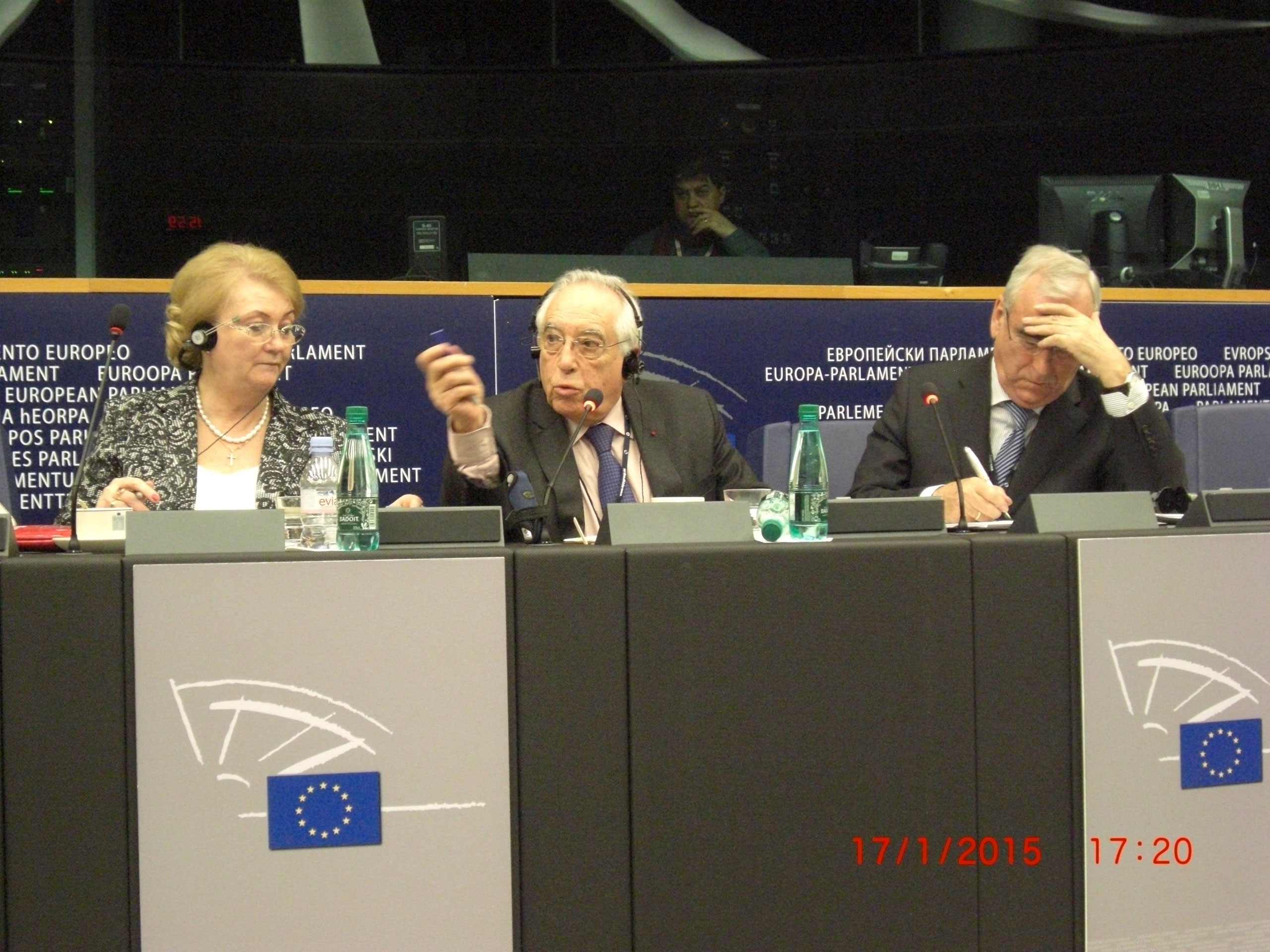
Opening
The delegations from the following countries were present: Austria, Belgium, Bosnia-Herzegovina, Bulgaria, Croatia, Czech Republic, France, Germany, Hungary, Latvia. Macedonia, San Marino, Serbia, Silésie, Slovakia, Slovenia, Spain, Sweden, Switzerland.
The International President Alain Terrenoire opened the conference on Friday 16th January 2015 at 3.15 P.M. and expressed thanks to a great number of attending delegates for their participation in the General Assembly. He especially thanked Mrs. Isabel von Kuehnelt Leddihn for the enormously hard work that she put in so that the General Assembly could take place. Under the thundering applause, he handed over to her a bunch of flowers. He also thanked Mrs. Chantal Berthelot for her efforts and hard work during the past years.
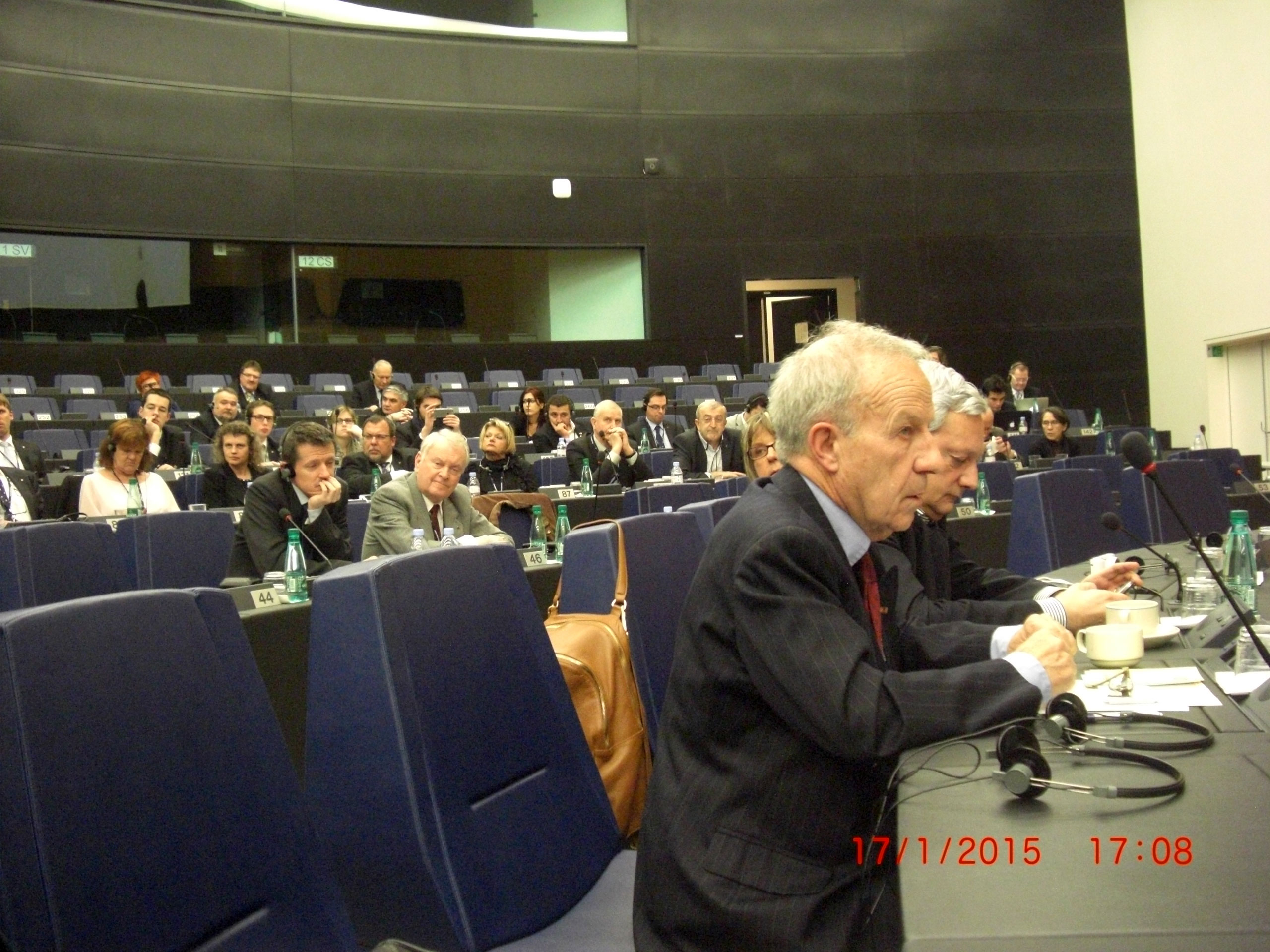
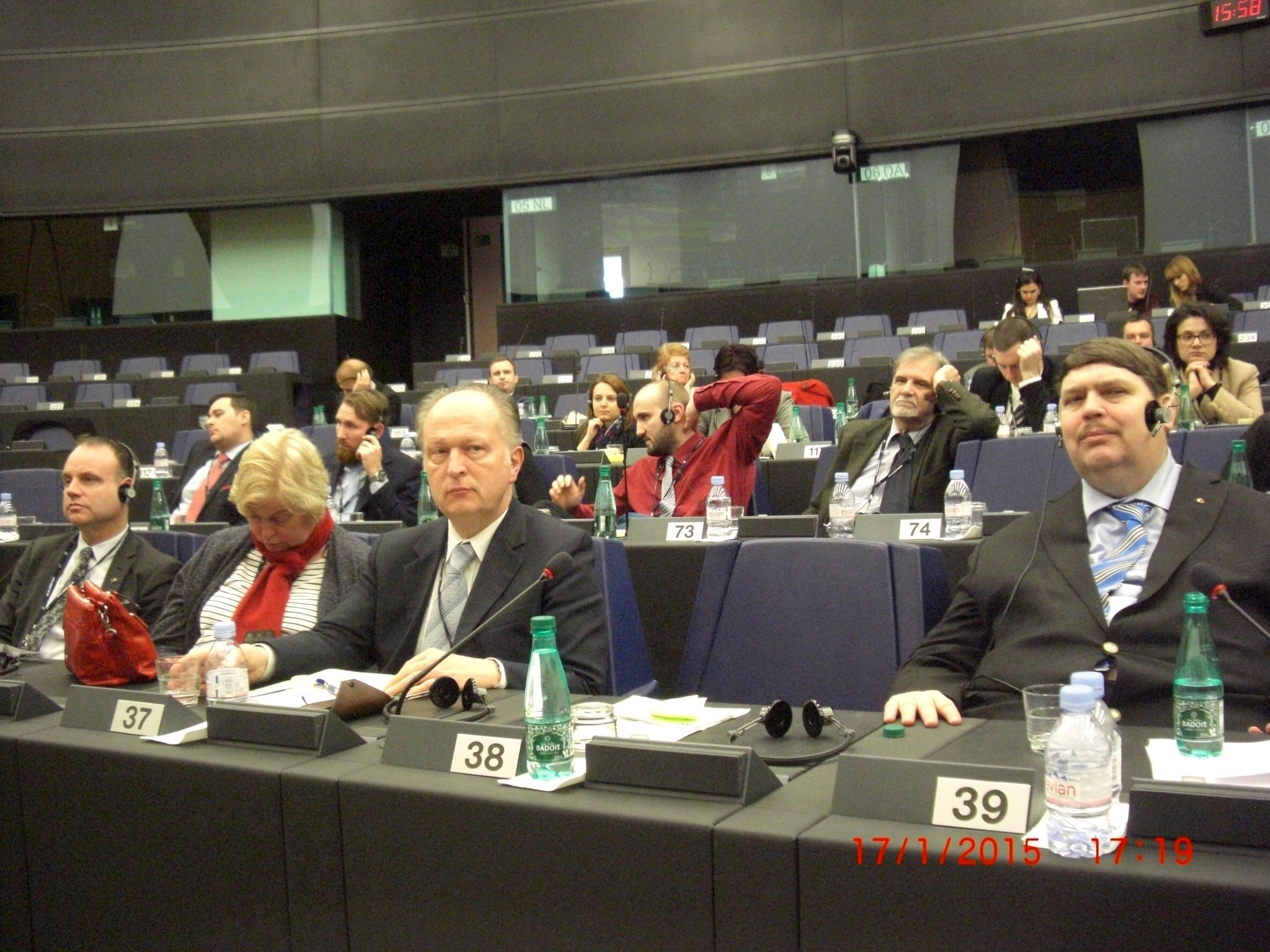
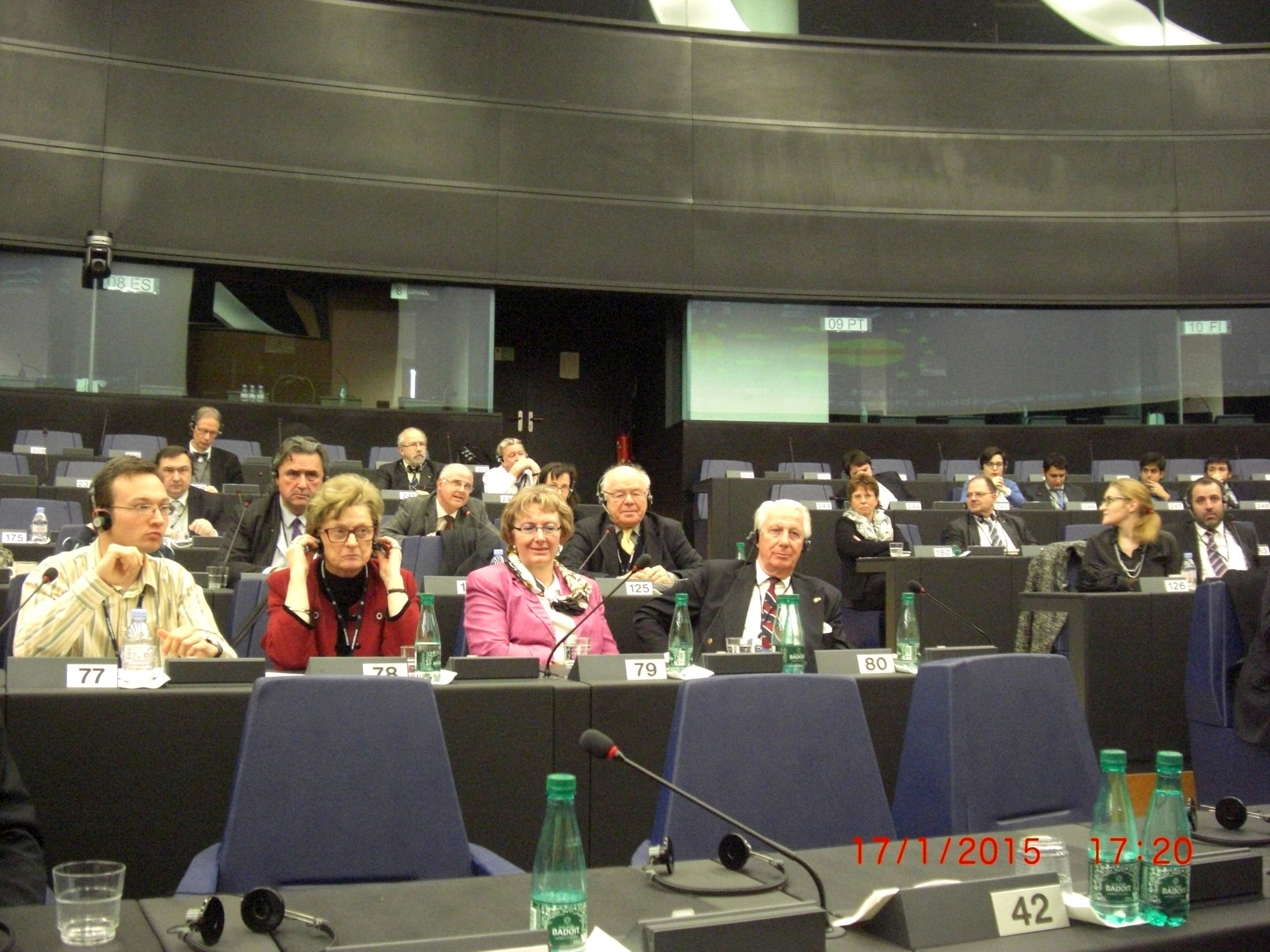
Secretary General's Report
In his Report, the Secretary General Marco Pons gave account of the most important activities undertaken during the past period. He especially stressed the importance of membership fees payment as well as of the regular submitting of notification for the Pan-Europe Information, on ground of which the Secretary General can get to know about the current activities. He also reminded that the Richard Coudenhove-Kalergi's Archives, which had until recently belonged to the University of Geneva, are now publicly available – from 17th November 2014 – in the Lausanne Cantonal Archives.
Financial Report of the International Treasurer
The International Treasurer André Poulin submitted his Report on the finances of the International Pan-European Union. Despite the reduced revenues during the past years, the accounting balance of the International Pan-European Union remained positive. It was especially stressed that all the outstanding debts of the International Pan-European Union, present at the moment when he took over the function, had been in the meantime successfully settled.
Auditors' Report
The Auditors Elke Frisch and Rainhard Kloucek confirmed the Financial Report to be regular on the debit and credit side for the years 2012, 2013 and 2014. They have also confirmed that the expenses were decreased and all the expenditures documented with receipts. At the same time, they put forward some proposals how to improve the Pan-European Union funding.
Discussion and Voting about Discharge
After a short discussion about submitted reports, the voting was carried out. The discharge for the 2012, 2013 and 2014 was given.
Election of President
When this agenda item was announced, President Alain Terrenoire retreated from presiding the Assembly. The acting Vice-President Walburga von Habsburg Douglas took over conducting of the Assembly. The Vice-President Mislav Ježić brought forward a proposal to elect Alain Terrenoire as President for the third term. While explaining his proposal, he pointed out that Alain Terrenoire has proven himself as a staunch Pan-European and excellent speaker, who, as President, has tirelessly and reliably attended and taken active part in all major activities of various Pan-European organisations. This proposal was wholeheartedly seconded by the Vice-President Karl von Habsburg Lothringen. There was no other candidate for President. By voting, Alain Terrenoire was unanimously elected for President. After the general acclamation and congratulations, he thanked for the great trust and confidence expressed to him and took over further conducting of the Conference.
Election of Presidency Members
The following members of the previous Presidency resigned and did not candidate for the new Presidency: Walburga von Habsburg Douglas, Marco Pons, André Poulin, Ingo Friedrich and Andrej Rahten. President Terrenoire sincerely thanked them all and held a special laudation on two Pan-Europeans who had since seventies significantly contributed to the work and development of the Pan-European movement – Countess Walburga Habsburg Douglas, many years member of the Swedish Parliament, and the retired Vice-President of the European Parliament Dr. Ingo Friedrich. At the end of the session on the second working day, all the Assembly participants paid tribute to the outgoing acting Vice-President Walburga von Habsburg Douglas by long ongoing standing ovations. She had 35 long years actively taken creative part in work and development of the International PEU, many years thereof as a member of Presidency, at the beginning as Secretary General and at the end as Acting Vice-President.
Twenty candidates were designated for the Presidency. In the first turn of voting 11 members of Presidency were elected with the required absolute majority: Karl von Habsburg (Austria), Carlos Uriarte Sanchez (Spain), Mislav Ježić (Croatia), Bernd Posselt (Germany), Hans Kijas (Germany), Anna Záborská (Slovakia), Franjo Topić (Bosnia-Herzegovina), Dirk Voss (Germany), Jean-Paul Picaper (France), Julien Vanderbeeken (Belgium) und Andrej Lepavcov (Macedonia).
The session ended at 7 P.M. Thereafter there was a reception at the Regional Council of Alsace given for the General Assembly participants. The Region Alsace extended its greetings to the delegates in its new, light-flooded centre, not far from the European Parliament buildings, located on the square named after the late great Pan-European from Alsace und Regional President Adrien Zeller.
The Assembly continued its session on Saturday 17th January 2015 at 9.15 A.M. In the second voting turn, 3 of the 8 remained candidates withdrew their candidatures: Stephan Graf Bethlen (Hungary), Dejan Hribar (Slovenia) and Pavol Drlička (Slovakia). Two further Presidency members were elected in the next turn of voting: Laris Gaiser (Slovenia) and Rainhard Kloucek (Austria). Anna Grünwald (Hungary) und Vojislav Mitić (Serbia) received the same number of votes. The third turn of voting was organised as to get the decision, and since Anna Grünwald received the majority of votes, she was elected in the Presidency.
The following designated candidates were not elected: Vojislav Mitić (Serbia), Marjan Švejda (Czech Republic) and Peter Lowe (Sweden).
Elke Frisch and Antoine Broquet were elected as auditors.
Presidency Meeting and election of Vice Presidents, Secretary General and Treasurer
At the Constitutional session of the Presidency Anna Záborská was elected as Acting Vice President, and additional three Vice Presidents were also elected: Mislav Ježić, Karl von Habsburg Lothringen and Dirk Voss.
On the proposal of the President Alain Terrenoire Pavo Barišić was co-opted to the Presidency. Thereafter he was unanimously elected for Secretary General. Julien Vanderbeeken was elected as Deputy Secretary General. Hans Kijas was elected for Treasurer.
Financial budget plan 2015 – Discussion and Voting
Treasurer Hans Kijas presented his plan for the budget for the year 2015. The proposed budget has been approved after some discussions followed by voting.
Keynote Speech of the President
In his keynote speech, the President Alain Terrenoire called for assertiveness and unanimous politics for Europe. Otherwise it will not be possible to master and overcome the upcoming great challenges – wars, migration waves and immigration, integration of the South-East European countries, development and building of a sovereign association which is technologically able to defend itself, and fight against the nationalist populist menace. In his speech, Terrenoire dealt at length with the Russsian expansionism and dangers which derive thereof for the countries as Ukraine, Georgia or Moldavia, "in the long run also for the whole Europe": "Pan-Europe we need more than ever!" He appealed for an "engagement - more than ever - in spirit of Richard Coudenhouve-Kalergi and Otto von Habsburg" and praised above all "our active Pan-European youth and member organisations on the whole continent for their tireless dedication to these causes".
Numerous members attending the conference took part in the subsequently followed political debate.
Activities of the Pan-European Members of Parliament Working Group
The Deputy Secretary General Julien Vanderbeeken gave an account of the activities of the Pan-European Members of Parliament Working Group.
Miscellaneous
Oleg Smirnov, Russian businessman resident in Geneva in Switzerland, informed about the initiative for founding of an association Pan-Europe Russia and expressed a wish for its establishing close relations with International Pan-European Union.
As prominent guest speaker at the General Assembly, the father of Euro, the former Finance Minister in the German Federal Government, Theo Weigel gave a lecture to the delegates, which was followed by a lively discussion. Close comrade in arms of Helmut Kohl in the European unification process, in the creation of the European Monetary Union and German reunification enlarged, as contemporary witness, upon numerous historic and new legends. Euro was neither a precipitate delivery, as it is often argued, nor a concession to the French for their "yes" to the German unification, but rather a since seventies planned milestone on the way towards a European federation. As early as 1988 at the summit in Hannover the Delors-Plan on the European currency was agreed upon, at the time when there was no mention of a German unification. In detailed discussion with Pan-European delegates Waigel has refuted point after point the current propaganda against Euro. On ground of comprehensive figures, he has shown how much the Europeans already today had benefitted from the long continuing stability of their currency. He pointed out that Euro was on the way to become the leading world currency.
Honorary CSU chairman objected emphatically against attempts to renationalise the EU. Not only that he invoked the Christian founding fathers Adenauer, Schuman and de Gasperi but he also cited the impassionate Pan-European Franz Josef Strauβ. He expressed his thanks to the President of the German Pan-European Union Bernd Posselt for defending the true Strauβ's European political heritage from all attempts of euro-sceptical adulteration. On ground of his historical knowledge, Strauβ was aware that the creation of the United States of Europe was in the long run a matter of life or death – of survival. Indeed this will not happen – says Waigel, "during the next five or ten years", but surely it will come to the "United States of Europe" which will be more than a confederation or a union of states. This Union should consist of concentric spheres: in the innermost part the countries in the European Monetary Union, encircled by other member states, then candidate countries and the associates.
Waigel highly valued Pan-European Union decades-long commitment for the politically united Christian Europe. Its union is not only a question of the economical greatness – the EU distinguishes itself through human rights and human dignity, as a community of values. In that way the Christian heritage will become real and understandable also for the agnostics: "When put in this context, reverence of God can be expected also from those who personally do not believe".
General Assembly ended at 6.30 P.M. with general acclamation.
The European capital city of Strasbourg received the Pan-Europeans in the historical Council Hall in which, on Richard Coudenhouve-Kalergi's initiative, the Council of Europe was founded in 1949.
In Strasbourg Cathedral – from which the inspiration for the European sign with twelve stars was taken – the chapter celebrated the Holy Mass with pageantry of colourful banners of Pan-European Youth. The Canon Michel Wackenheim welcomed the Pan-Europeans from some twenty member organisations in the Lord's House which was founded by Bishop Werner von Habsburg and which celebrates 1000 years in 2015, with an address about the importance and history of the oldest European unification movement.
Pavo Barišić, Secretary General
Translated into English by Jasna Čmelić